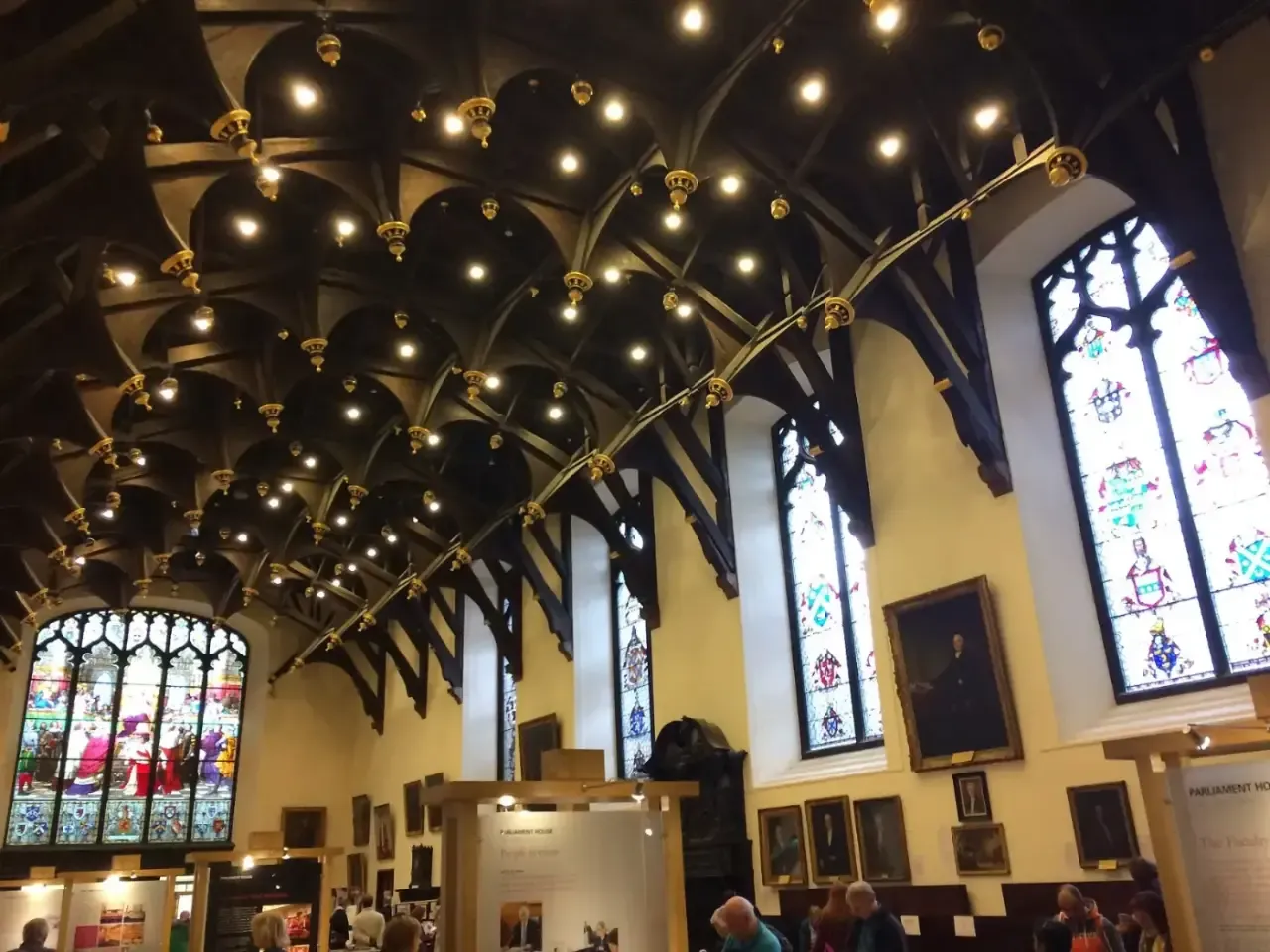
On 1 May 1707 the Union of 1707 came into force. Scotland and England, which had shared a monarch since 1603, became a single Kingdom of Great Britain with one parliament at Westminster. Few events in Scottish history have been argued over for longer.
How the Treaty of Union was agreed
Commissioners for each kingdom met in London between April and July 1706. They agreed a treaty of 25 articles, which was signed at Whitehall on 22 July 1706. After that, each country’s parliament had to pass it.
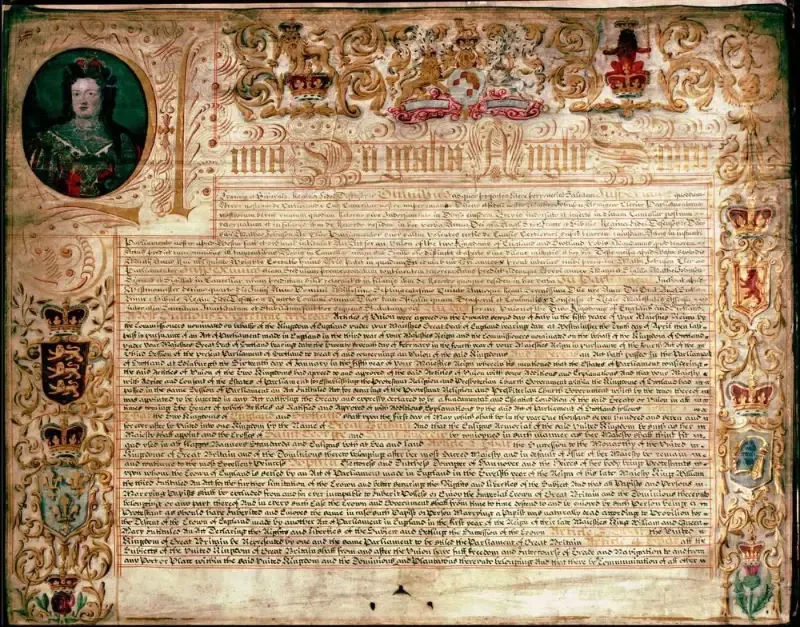
The Scottish exemplification (official copy) of the Treaty of Union, 1707. Public domain, via Wikimedia Commons.
The vote in Edinburgh
The Scottish Parliament met in Parliament Hall in Edinburgh and debated the articles over the winter of 1706–07. Meanwhile, petitions against the Union arrived from shires, burghs, presbyteries and parishes across the country. Even so, on 16 January 1707 Parliament ratified the treaty as a whole, by 110 votes to 69. The English and Scottish acts of ratification took effect on 1 May that year.
Why the Union of 1707 came about
Several pressures lay behind it. Scottish investors had put a great deal of money into the Company of Scotland’s Darien scheme, a colony on the isthmus of Panama, and they lost heavily when it failed. Then, in 1705, the English Parliament passed the Alien Act. It threatened to treat Scots as foreigners unless Scotland opened talks on who would succeed to the throne. Historians still weigh how much each of these mattered, alongside trade, religion, security and the management of votes in Parliament.
What the treaty changed
- Representation. Scotland gained 45 members in the House of Commons and 16 representative peers in the House of Lords.
- The Equivalent. Article 15 granted Scotland £398,085 and ten shillings to offset its share of England’s national debt. Most of it went to compensate investors in the Darien scheme.
- Trade. Scotland gained access to English markets and colonies within a single customs union.
What it kept
The treaty and the acts around it kept the Church of Scotland as the established church. They also kept the Court of Session in Scotland and left Scots law in force. These guarantees are a large part of why Scotland kept such a distinct identity inside the new state.
Further reading
Chris Whatley has written about the Union for more than thirty years. His books include Bought and Sold for English Gold? Explaining the Union of 1707 (1994; second edition 2001) and The Scots and the Union (2006), which won the Saltire Society’s Scottish History Book of the Year in 2007. The second edition, The Scots and the Union: Then and Now, followed in 2014.