Victorian Dundee is often pictured as a grim mill town of smoke, dust and long hours. Yet the same textile money also paid for green space. Baxter Park, opened in 1863, was given to the city by one of its leading linen families, and it is still one of Dundee’s best-loved parks.
The Baxters of Dens Works
The Baxter family were linen manufacturers. William Baxter and his son Edward built their first mill on the Dens Burn in 1822, and the firm became Baxter Brothers & Co. in 1825. Their Dens Works grew into what was described as the world’s largest maker of linen sailcloth and canvas. At its peak the firm employed about 5,000 people.
Sir David Baxter became head of the firm after his father died in 1854. In 1861 he and his sisters, Mary Ann and Eleanor Baxter, bought land on the east side of the town for a public park.
Baxter Park, designed by Joseph Paxton
To lay it out they hired Sir Joseph Paxton, the designer of the Crystal Palace in London. Drawn up in 1862–63, it is the only complete park in Scotland designed wholly by Paxton. It covers around 37 acres, with sweeping lawns, curving paths and belts of trees.
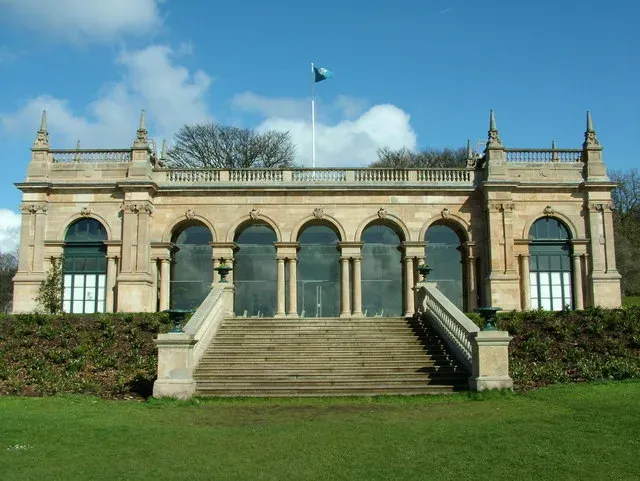
At its heart stands a two-storey pavilion in the style of an Italian Renaissance building, designed by Paxton’s son-in-law, G. H. Stokes. Laying out the park cost £40,000, and the family set aside a further £10,000 for its upkeep.
For “the working population”
The title deed of 1863 is clear about who the park was for. It was to give “the working population the means of relaxation and enjoyment after their hard labour and honest industry”. Many people in the city, including children, worked long shifts in noisy and dusty mills.
Opening day, 9 September 1863
The park opened on 9 September 1863. The day was a public holiday, and the Prime Minister, Earl Russell, performed the ceremony. Historic Environment Scotland records a procession of local people two miles long. Estimates of the crowd vary widely, from around 30,000 to 80,000.
A marble statue of David Baxter by the sculptor John Steell, paid for by public subscription, was placed in the pavilion. It was later moved to the McManus Galleries and has since returned to the park. David Baxter was knighted in the same year the park opened.
Decline and restoration
Like many Victorian parks, Baxter Park went through hard times. For years the pavilion stood derelict. In 2003 the Heritage Lottery Fund granted £3.25 million towards a restoration costing about £5 million in all, with Historic Scotland and Dundee City Council. The restored park reopened in 2007, and it won a Green Flag Award in 2009.
Today the pavilion, its steps, walls and gate piers hold Category A listing. Since 2006 the park has also appeared on Scotland’s Inventory of Gardens and Designed Landscapes.
The textile money behind it
The fortunes made in linen and later in jute, the subject of our guide to how Dundee became Juteopolis, also paid for parks, galleries and public buildings.
Further reading
For the city’s civic life beyond the mill-town image, see Victorian Dundee: Image and Realities, which Chris Whatley edited with Bob Harris and Louise Miskell. For the textile industry that paid for it all, see The Triumph of Textiles: Industrial Dundee, c. 1700–1918, by Chris Whatley and Jim Tomlinson.
Key facts
- When did Baxter Park open?
- On 9 September 1863, opened by the Prime Minister, Earl Russell, on a public holiday.
- Who designed Baxter Park?
- Sir Joseph Paxton, the designer of the Crystal Palace. It is the only complete park in Scotland designed wholly by him.
- Who gave the park to Dundee?
- Sir David Baxter and his sisters Mary Ann and Eleanor, of the linen firm Baxter Brothers & Co.
- Who was the park for?
- Its 1863 title deed says it was for “the working population”, to give them relaxation and enjoyment after their hard labour.
Sources
- Historic Environment Scotland: Baxter Park, Inventory of Gardens and Designed Landscapes (GDL00051) (opens in a new tab)
- Historic Environment Scotland: Baxter Park pavilion, listed building (LB24992) (opens in a new tab)
- Dundee City Council: Sir David Baxter (opens in a new tab)
- Wikipedia: Baxter Park (opens in a new tab)
- Wikipedia: Joseph Paxton (opens in a new tab)
- Archives Hub: Baxter Brothers & Co. records (opens in a new tab)
- Canmore: Upper Dens Mills, Dundee (opens in a new tab)